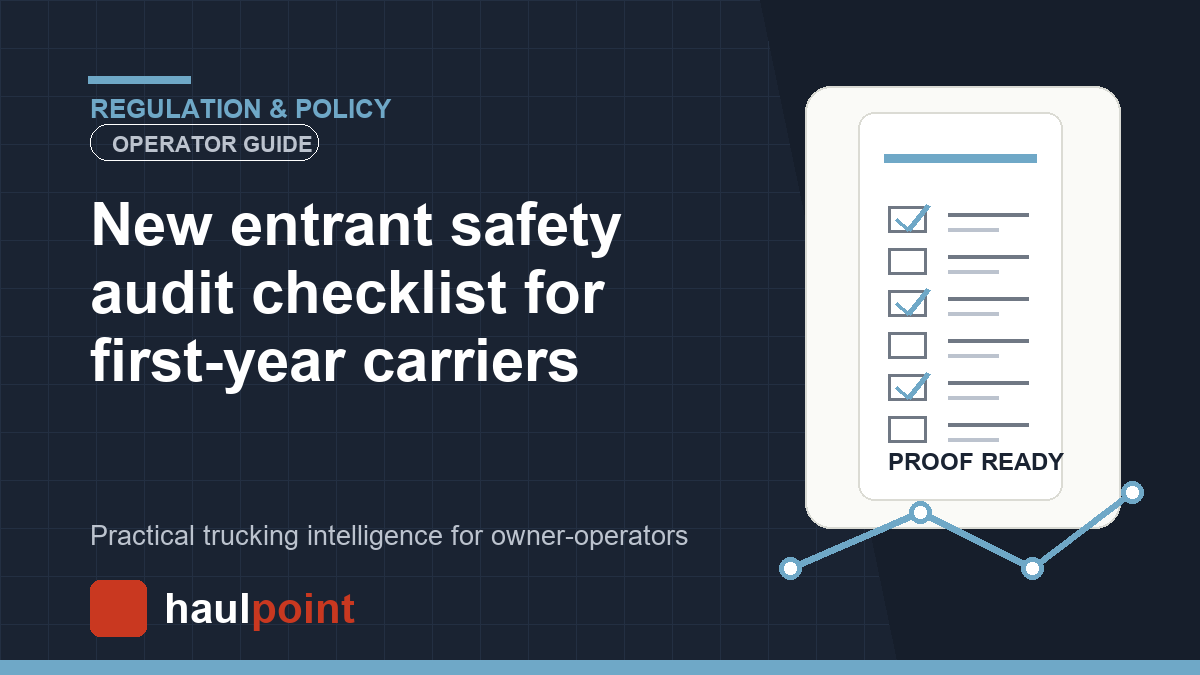
New entrant safety audit checklist for first-year carriers
FMCSA monitors new interstate carriers for 18 months, and a safety audit is part of that period. Here is what to organize before the letter arrives.
The New Entrant Safety Assurance Program is not a rumor that only applies to fleets. If you start as an interstate motor carrier, FMCSA monitors you during an initial 18-month period. FMCSA also says a safety audit will be conducted within 12 months after the New Entrant begins operations. The best time to prepare is before the letter arrives.
What is the new entrant period?
FMCSA uses the new entrant period to monitor newly registered interstate carriers. The carrier must operate safely, maintain up-to-date records, conduct periodic inspections and maintenance, and pass the safety audit. FMCSA monitors safety performance through roadside inspections and reviews whether the carrier has basic safety management controls.
That phrase – basic safety management controls – is the point. The audit is not just about whether your truck looks clean. It is about whether your business can prove that drivers, vehicles, hours, inspections, insurance, and records are being managed.
What should be ready before the audit?
Start with driver qualification files. For every driver, including yourself, keep the CDL copy, medical certificate or MVR status where applicable, road test or equivalent documentation, employment application, prior-employer safety performance checks when required, and annual review records. If you hire a driver in a hurry and build the file later, you are building audit stress into the business.
Next, organize hours-of-service records. Know the basics in our hours-of-service guide, and make sure your ELD is still on FMCSA’s registered list. If your device was removed, our ELD registered-list guide explains why waiting can create a compliance problem.
Vehicle maintenance records
Maintenance is where new carriers often get sloppy because repairs feel obvious in the moment and invisible later. Keep inspection reports, repair invoices, periodic inspection records, tire records where useful, and a maintenance schedule. If you lease onto a carrier later, do not assume those old records become irrelevant. Your authority record still needs a clean story for the period you operated.
Insurance, authority, and process records
Keep proof of insurance, operating authority records, BOC-3 confirmation, UCR receipts, and any registration documents together. FMCSA states that once operating authority is granted, entities are required to maintain proof of insurance and designation of process agents on file to avoid revocation proceedings. This is not glamorous paperwork, but it protects the authority you paid to build. If you are still setting up, read how to get your own authority and owner-operator insurance.
Roadside inspections matter too
The safety audit is not the only signal FMCSA sees. Roadside inspections feed your safety record, and new entrants are monitored through those inspections during the same period. Keep a habit of reviewing inspection reports and correcting defects fast. Our CSA score guide explains how safety data follows a carrier after the startup phase.
What happens if you pass?
Passing the safety audit is a milestone, not a finish line. FMCSA says if the audit shows adequate basic safety management controls, the agency provides written notice, but safety performance continues to be monitored for the remainder of the 18-month new entrant period. If no later safety performance problems appear, the carrier can graduate and continue under CSA monitoring.
Bottom line
Do not wait for the audit letter to discover what records you should have kept. Build the folders now: driver qualification, HOS/ELD, inspections, maintenance, insurance, authority, BOC-3, UCR, and corrective actions. The audit is much less scary when the business already runs like someone could inspect it tomorrow.
Frequently asked questions
How long is the new entrant period?
FMCSA says new entrants are monitored during an initial 18-month period.
When does the safety audit happen?
FMCSA says a safety audit will be conducted within 12 months after the new entrant begins operations.
What does the safety audit review?
The audit reviews whether the carrier has basic safety management controls, including required records, inspections, maintenance, driver qualification, hours-of-service, and safety practices.
What happens after passing?
FMCSA says safety performance continues to be monitored for the remainder of the 18-month new entrant period.
More like this.
Real equipment analysis, rate moves, and regulatory updates — without the press release padding.